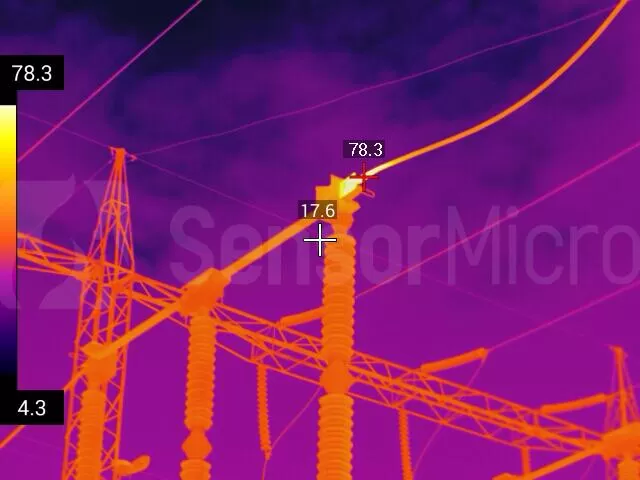
Customer Industry: Power Transmission & Distribution
Application Scenario: Live Equipment Thermal Inspection in 220kV Substation
Background
In a 220kV substation located in Pune, India, ensuring the safe and stable operation of high-voltage electrical equipment is critical to maintaining grid reliability. During normal operation, both high- and low-voltage systems can develop thermal anomalies due to factors such as aging components, poor connections, or increased load conditions.
These thermal irregularities often serve as early warning signs before a failure occurs. When a fault begins to develop, it typically manifests as a localized hotspot, forming a distinct thermal field that radiates heat outward. Detecting these hotspots in time is essential to prevent unexpected outages and costly damage.
With the advancement of infrared technology, thermal imaging has become an increasingly effective tool in the power industry, enabling non-contact, real-time inspection of energized equipment and providing intuitive visualization of potential faults.
Challenges
Before adopting infrared thermal imaging, substation inspection and maintenance faced several limitations:
Inability to inspect live equipment safely: Traditional methods often required shutdowns or indirect measurements
Limited fault visibility: Early-stage thermal defects were difficult to detect with conventional tools
Inefficient inspection process: Manual inspections lacked speed and comprehensive coverage
High risk of unexpected failures: Undetected overheating could lead to equipment damage or outages
As the substation operates continuously under high voltage and load conditions, these challenges posed significant risks to operational safety and reliability.
Solution
To enhance inspection efficiency and fault detection capability, infrared thermal imaging was introduced for routine monitoring of key substation equipment, including:
Using a thermal imaging camera, maintenance teams were able to:
Perform non-contact inspection on energized equipment
Visualize the full-field temperature distribution in real time
Quickly identify abnormal hotspots and thermal patterns
Accurately locate potential fault points based on temperature differences
Case Findings
1. 220kV Current Transformer (CT)
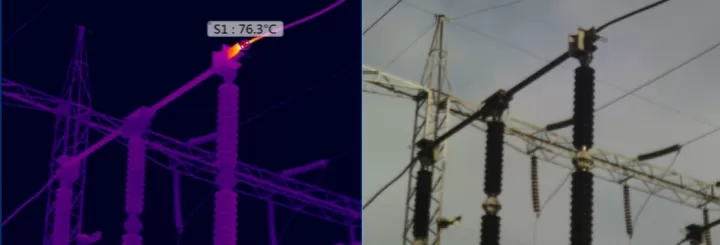
Defect Type: Joint aging causing overheating
Hotspot Temperature: 78.3°C
Normal Phase Temperature: 30.4°C
Ambient Reference Temperature: 22°C
Temperature Difference (ΔT): 47.9°C
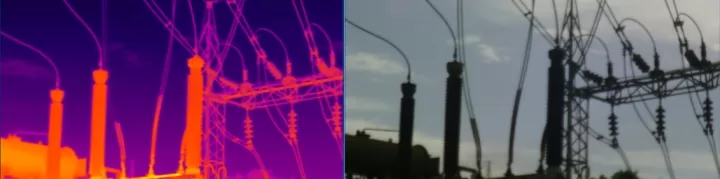
2. 220kV Voltage Transformer (VT)
3. 220kV Current Transformer (CT)
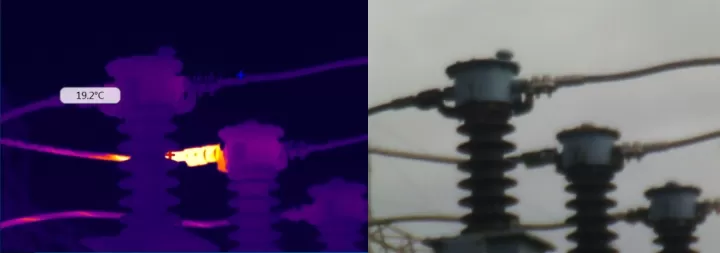
Defect Type: Joint aging causing overheating
Hotspot Temperature: 129.8°C
Normal Phase Temperature: 30.7°C
Ambient Reference Temperature: 22°C
Temperature Difference (ΔT): 99.1°C
4. 220kV Current Transformer (CT)
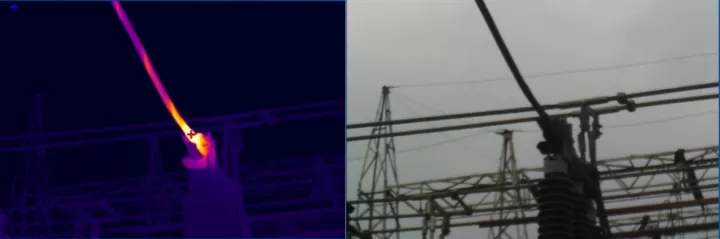
Defect Type: Joint aging causing overheating
Hotspot Temperature: 110.3°C
Normal Phase Temperature: 30.7°C
Ambient Reference Temperature: 22°C
Temperature Difference (ΔT): 79.6°C
5. 220kV Insulator Jumpers
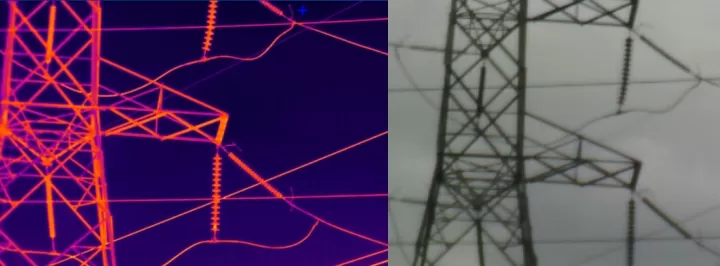
The thermal images clearly revealed localized overheating at connection points, confirming insulation degradation and contact resistance increase as the root causes.
Benefits of Infrared Imaging Technology in Substation Inspection
After implementing infrared thermal imaging for substation inspection, the customer achieved:
Early fault detection: Identification of overheating joints before failure
Improved operational safety: Reduced risk of unplanned outages
Efficient maintenance planning: Targeted repairs based on accurate diagnostics
Non-intrusive inspection: No need for power shutdowns during inspection
By enabling real-time visualization of thermal behavior, infrared imaging provided a powerful diagnostic tool for predictive maintenance in high-voltage environments.
For power transmission and distribution systems, especially in high-voltage substations, early detection of thermal faults is essential to ensure system reliability and safety. Infrared thermal imaging offers a fast, accurate, and non-contact solution for identifying hidden defects in energized equipment.


 CN
CN
 EN
EN