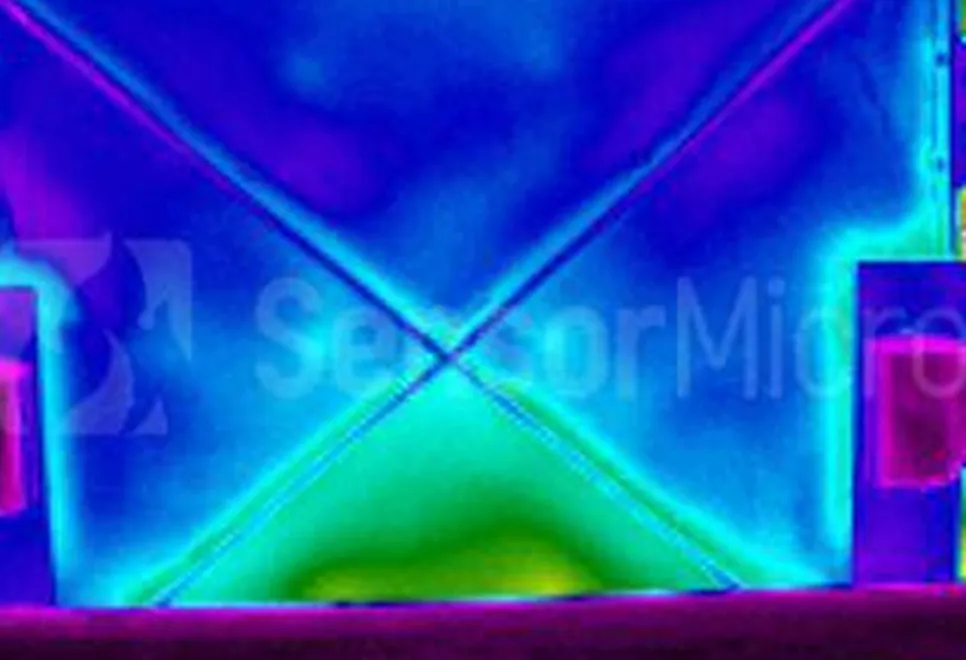
Yes, thermal cameras can detect many hidden water leaks, but not because they “see” water directly. Instead, they identify temperature differences caused by moisture evaporation, heat retention, or cooling effects inside walls, ceilings, floors, and pipes. In real-world inspections, thermal imaging often helps technicians locate leaks significantly faster than traditional trial-and-error methods, reducing unnecessary wall demolition and shortening inspection time from several hours to less than 30 minutes in many cases.
How Thermal Cameras Actually Find Water Leaks
A thermal camera does not detect water molecules. It measures infrared radiation and converts surface temperature differences into a visual image. When water leaks into building materials, it changes how those materials absorb, store, and release heat. Wet drywall, insulation, wood, or concrete usually cools or heats differently from surrounding dry materials, creating a thermal anomaly that becomes visible through infrared imaging.
For example, a leaking cold-water pipe behind drywall often creates a cooler thermal signature because evaporation lowers the surface temperature. A hot-water pipe leak produces the opposite effect and typically appears warmer than surrounding areas. Ceiling leaks may spread outward in irregular shapes, while wall leaks often create downward triangular patterns due to gravity-driven moisture movement. These recognizable thermal patterns help inspectors narrow down the probable leak location without opening large sections of the building.
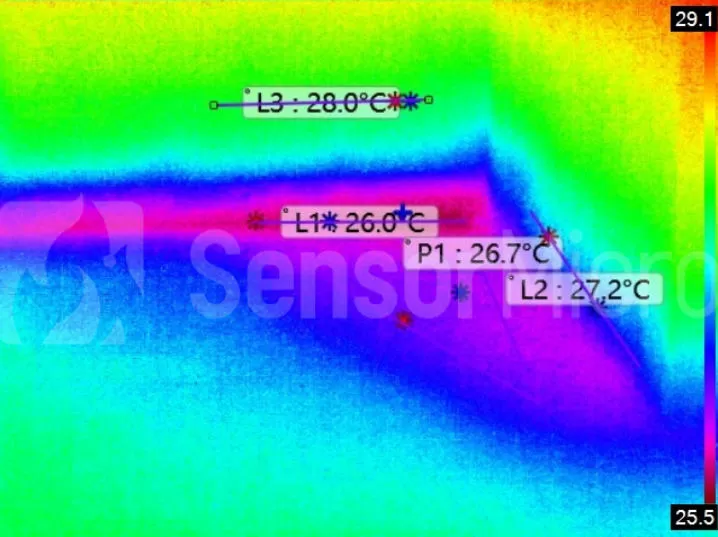
In practical building inspections, this difference is substantial. Traditional leak tracing may require cutting multiple inspection holes before locating the source, especially when water travels far from the visible stain. Thermal imaging can often reduce invasive inspection areas by more than 70%, particularly in multi-story buildings where leaks migrate through ceilings and wall cavities before becoming visible.
Why Thermal Imaging is Faster Than Traditional Leak Detection
Conventional leak detection usually relies on visual inspection, moisture meters, pressure testing, or destructive exploration. These methods work, but they are slower and often reactive rather than preventive.
Thermal imaging changes the workflow because inspectors can scan large surfaces in seconds. Instead of opening multiple wall sections, they first identify suspicious thermal anomalies and then verify them with secondary tools.
A common failure lesson in residential inspections is assuming that visible water stains represent the actual leak source. In many homes, water travels several meters before becoming visible. Contractors sometimes repair the stained area only to discover the leak persists because the true entry point was higher up the structure. Thermal imaging helps reveal the continuous thermal pathway from the source to the visible damage, reducing repeat repairs and customer callbacks.
This speed advantage becomes even more important in commercial buildings, hotels, hospitals, and data centers where downtime is expensive. A technician using thermal imaging may inspect dozens of rooms in the time required for one invasive inspection.
What Conditions Make Leak Detection Easier?
Thermal leak detection works best when there is sufficient temperature contrast between the wet area and surrounding materials. The stronger the thermal contrast, the easier the leak is to identify.
Several factors strongly affect inspection quality:
1. Indoor-outdoor temperature differences
2. HVAC operation
3. Evaporation rate
4. Pipe temperature
5. Material emissivity
6. Surface reflectivity
7. Weather conditions
For example, a cold rainy day with indoor heating often produces excellent thermal contrast because wet materials cool differently from dry surfaces. Similarly, air-conditioned buildings in hot climates usually generate clearer moisture signatures because the cooled interior amplifies thermal variation.
By contrast, newly dried leaks or thermally stable environments may produce little detectable difference. This is one reason inexperienced users sometimes conclude that “thermal cameras don’t work for leaks” when the real issue is insufficient thermal separation.
A recent discussion among professional users highlighted another common mistake: scanning glossy ceramic tiles without adjusting emissivity settings. Reflective tile surfaces can distort readings and hide moisture signatures entirely. Experienced inspectors often place electrical tape on reflective surfaces to stabilize emissivity calibration before measurement.
Why Thermal Sensitivity Matters More Than Resolution
Many buyers focus only on thermal resolution, but for water leak detection, thermal sensitivity — often expressed as NETD — is equally important.
A camera with lower NETD can distinguish smaller temperature differences. This difference matters because moisture anomalies are often subtle. A low-sensitivity camera may completely miss early-stage water intrusion that a more sensitive device can detect clearly.
Consider this comparison:
Thermal Sensitivity | Typical Leak Detection Performance |
≤30mK | Detects subtle moisture differences and early intrusion |
~50mK | Adequate for most residential inspections |
≥100mK | May miss minor or slow leaks |
Another important lesson from field inspections is that image quality alone does not guarantee accurate diagnosis. Some users rely too heavily on fusion imaging or automatic color palettes and overlook environmental influences. Community reports have shown that improper image alignment, condensation, or calibration issues can create misleading thermal interpretations if the device is not configured correctly.
Can Thermal Cameras Detect Leaks Behind Walls and Floors?
In many cases, yes. Thermal cameras are especially effective for detecting leaks behind drywall, ceilings, under flooring, and inside insulation cavities when moisture changes the surface temperature enough to become visible.
Common applications include:
Plumbing leaks behind walls
Roof leaks
Underfloor heating failures
HVAC condensation problems
Bathroom waterproofing failures
Pipe leaks beneath concrete slabs
Moisture intrusion around windows
However, inspectors must understand the limitations. Thick concrete, metal cladding, highly reflective surfaces, or deeply buried pipes can reduce detection reliability. Thermal cameras only measure surface temperature patterns, so if the leak does not affect the surface thermally, it may remain invisible.
This limitation becomes obvious in underground pipeline inspections. Thermal imaging can sometimes help identify leak zones near the surface, but acoustic leak detection and pressure analysis are often more reliable for municipal water systems because they detect the leak signal directly rather than relying on secondary thermal effects.
Why Professionals Still Use Moisture Meters
One of the biggest misconceptions is believing thermal imaging alone confirms the presence of water. It does not.
A thermal anomaly simply indicates a temperature difference. That difference could be caused by moisture, but it could also result from missing insulation, air leakage, reflective surfaces, HVAC airflow, or electrical heat sources.
That is why professional inspectors typically follow a two-step workflow:
1. Use thermal imaging to rapidly identify suspicious areas.
2. Confirm moisture presence with a moisture meter or invasive inspection.
Skipping the verification step creates a major risk of false positives. In restoration projects, this can lead to unnecessary demolition costs or missed insurance claims.
A useful comparison from field inspections shows the difference clearly:
Inspection Method | Typical Inspection Speed | Invasiveness |
Visual inspection only | Slow | Low |
Moisture meter only | Moderate | Moderate |
Thermal imaging + moisture verification | Fast | Low |
Exploratory demolition | Very slow | High |
Choosing the Right Thermal Camera for Water Leak Detection
Not every thermal camera is suitable for moisture inspections. Cameras designed for industrial maintenance may prioritize wide temperature ranges over subtle thermal sensitivity.
For leak detection, professionals usually prioritize:
Low NETD thermal sensitivity
Adequate thermal resolution
Manual span and level adjustment
Good image stability
Moisture inspection workflow tools
Fusion imaging for context
Modern handheld and smartphone-connected thermal cameras have also lowered the barrier to entry. What once required thousands of dollars in specialized equipment is now accessible to contractors, home inspectors, restoration professionals, and even DIY homeowners.
Still, cheaper devices often struggle with fine thermal gradients, slower refresh rates, or poor calibration consistency. In moisture inspections, these weaknesses become obvious quickly because leak detection depends heavily on subtle temperature differentiation rather than dramatic heat signatures.
When Thermal Imaging Fails
Thermal imaging is powerful, but there are situations where it may fail completely:
The leak has already dried
Surface temperature is uniform
Materials block thermal transfer
Environmental conditions reduce contrast
Reflective surfaces distort readings
The leak is too small or too deep
One common inspection failure occurs immediately after rainfall stops. If enough time passes for evaporation and thermal equalization, the thermal signature may disappear even though moisture remains trapped inside the structure. Inspectors sometimes recreate leak conditions with controlled water testing to restore detectable thermal contrast.
Another frequent issue is over-reliance on automation. Auto-scaling color palettes can hide subtle anomalies by continuously adjusting the thermal range. Skilled thermographers often manually narrow the temperature span to make minor moisture differences stand out more clearly.
Summary
Thermal cameras can effectively detect many hidden water leaks by identifying temperature differences caused by moisture, evaporation, and heat transfer rather than detecting water directly. Compared with traditional leak tracing methods, thermal imaging significantly reduces inspection time and minimizes destructive wall or ceiling removal. The technology works best when there is strong thermal contrast between wet and dry materials, which is why environmental conditions and camera sensitivity are critical factors. Cameras with lower NETD values generally perform better for subtle moisture detection. However, thermal imaging alone cannot confirm the presence of water, and professional inspectors typically combine it with moisture meters for verification. While thermal cameras are highly useful for walls, ceilings, floors, roofs, and plumbing inspections, reflective materials, poor calibration, uniform temperatures, and deep leaks can still produce false readings or missed detection.


 CN
CN
 EN
EN