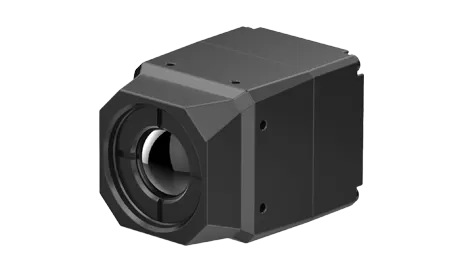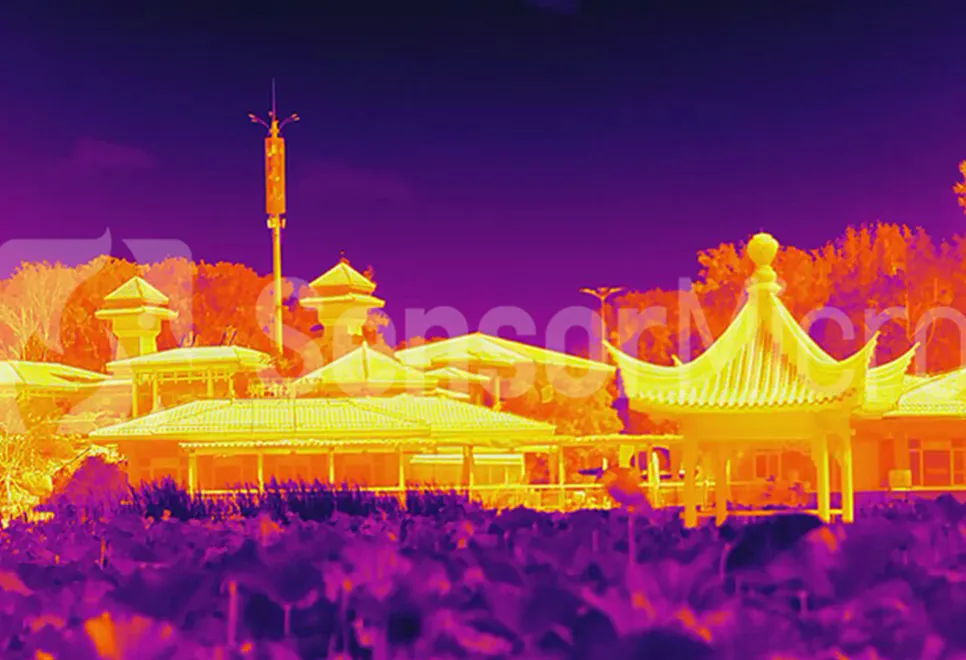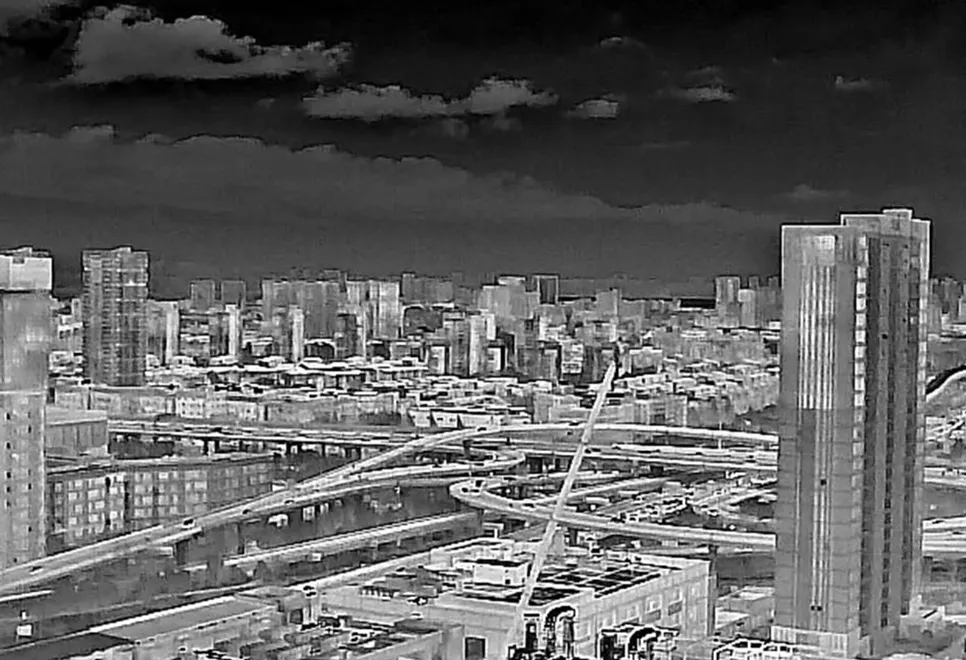
Infrared thermal imaging technology allows people to see heat instead of visible light. It is widely used in security, surveillance, industrial inspection, firefighting, and long-range observation.
Among different thermal imaging technologies, cooled IR camera cores offer the highest sensitivity and longest detection range. But how does a cooled IR camera core actually work?
What is Infrared Radiation?
All objects with a temperature above absolute zero (-273°C) emit infrared radiation, also called thermal radiation. Infrared radiation exists everywhere in nature. Even in complete darkness, objects continue to emit heat energy. The atmosphere absorbs much of the visible light and near-infrared light, but it is highly transparent to infrared wavelengths in 3–5 μm (MWIR) and 8–14 μm (LWIR). These two wavelength ranges are known as the “atmospheric windows.” Because infrared waves can pass through darkness, smoke, haze, and light fog, thermal imaging systems can clearly detect targets in difficult environments where visible cameras cannot work effectively.
What is a Cooled IR Camera Core?
A cooled IR camera core is a thermal imaging system that uses a cryogenic cooler to reduce the temperature of the infrared detector. The detector inside the camera is cooled to extremely low temperatures, sometimes as low as -196°C (-321°F). Cooling the detector greatly reduces internal thermal noise. This allows the detector to capture very small temperature differences from distant targets. Compared with uncooled thermal cameras, cooled IR camera cores provide higher sensitivity, sharper image quality, longer detection range, better target recognition, and more accurate thermal measurement.
How does a Cooled IR Camera Core Work?
The working process of a cooled infrared camera core can be divided into several steps.
3.1 Objects Emit Infrared Radiation
Every object emits heat energy as infrared radiation. The higher the temperature of a body or object, the more radiation it emits, but even objects with very small temperature differences can still be detected by cooled thermal cameras.
3.2 Infrared Energy Passes Through the Lens
The infrared radiation enters the thermal imaging system through a special infrared lens. Cooled thermal cameras can operate in different infrared wavelength bands, including MWIR(3–5 μm) and LWIR (8–14 μm). MWIR cooled thermal cameras are widely used for long-range detection and high-performance imaging, while LWIR cooled systems are suitable for applications requiring enhanced thermal sensitivity under different environmental conditions.
3.3 The Cryocooler Cools the Detector
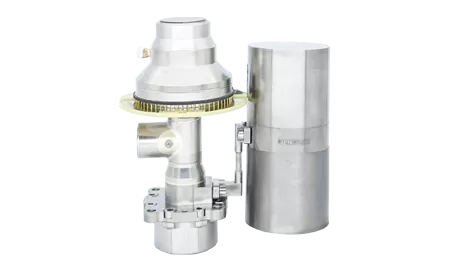
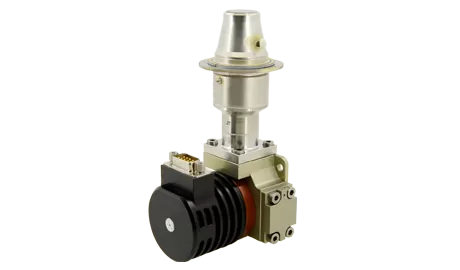
The cryocooler is one of the most important parts of a cooled IR camera core.
Since thermal cameras detect heat, any heat generated inside the camera itself can create unwanted background noise. The cryocooler reduces the detector temperature to cryogenic levels, dramatically lowering this internal noise. As a result, the detector becomes much more sensitive, tiny temperature differences can be detected, and long-range targets become clearer.
3.4 The Detector Converts Infrared Energy into Electrical Signals
The cooled infrared detector captures the incoming infrared radiation and converts it into electrical signals.
3.5 The Image Processing System Creates a Thermal Image
The electrical signals are processed by image algorithms inside the camera core. The system then generates a visible thermal image in which different temperatures appear as distinct colors or grayscale levels.
Why are Cooled IR Camera Cores More Sensitive?
Cooled IR camera cores are extremely sensitive because cooling removes most of the self-generated thermal noise of detectors.
This allows the system to detect targets with only a few degrees of temperature difference from the background.
With long-range optics, cooled MWIR thermal cameras can achieve ultra-long detection distances. This level of performance is difficult for uncooled IR cameras to achieve.
Cooled vs. Uncooled IR Camera Cores
IR cameras generally use either cooled or uncooled infrared detectors.
| Advantages | Disadvantages |
Cooled IR Camera Cores | | Higher cost More complex structure Requires a cryocooler
|
Uncooled IR Camera Cores | | Lower sensitivity Shorter detection range Less image detail
|
Applications of Cooled IR Camera Cores
Because of their superior performance, cooled thermal imaging systems are widely used in long-range security monitoring, forest fire prevention, scientific research, and industrial monitoring. In many long-range applications, a cooled IR camera can monitor an area 5–8 times larger than an uncooled IR camera.
Conclusion
Cooled IR camera cores work by detecting infrared radiation and using a cryocooler to reduce detector temperature and thermal noise. This technology provides extremely high sensitivity, longer detection range, and clearer thermal images, especially in challenging environments such as darkness, smoke, haze, and long-distance observation.
Although cooled IR cameras are more expensive than uncooled IR cameras, their superior performance makes them essential for many advanced infrared imaging applications.


 CN
CN
 EN
EN